
Rework rp2040 examples and CMake build:
	- Examples should be CMake buildable from their own subdirectory; such a build will error out based on
	  matching .skip.MCU_xxx or a mismatched .only.MCU_
	- It should be possible to build from a higher level and use .skip.MCU_ and .only.MCU_ to filter which
          examples get built
	- The intention is for the CMakeLists.txts in the examples to be non family specific and without MCU based IFs. I have
          started this work, but am not really sure the state of the esp32 stuff; in any case the plan is to have
          everything encapsulated in the FAMILY/family.cmake
	- pico_examples now just includes examples/device/CMakeLists.txt and examples/host/CMakeLists.txt directly, as they
	  also build correctly when included from there.
Note that .skip.MCU_ for esp32 in the directories it wasn't previously avaiable has not been added, as the .skip is common to the regular Makefile builds also. It isn't clear whether these examples should build for esp32, but if not .skip should be added.



TinyUSB is an open-source cross-platform USB Host/Device stack for embedded system, designed to be memory-safe with no dynamic allocation and thread-safe with all interrupt events are deferred then handled in the non-ISR task function.
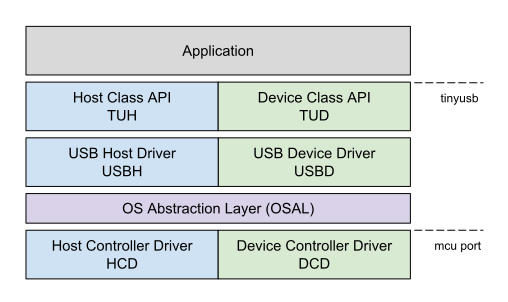
.
├── docs            # Documentation
├── examples        # Sample with Makefile build support
├── hw
│   ├── bsp         # Supported boards source files
│   └── mcu         # Low level mcu core & peripheral drivers
├── lib             # Sources from 3rd party such as freeRTOS, fatfs ...
├── src             # All sources files for TinyUSB stack itself.
├── test            # Unit tests for the stack
└── tools           # Files used internally
Special thanks to all the people who spent their precious time and effort to help this project so far. Check out the CONTRIBUTORS.md file for the list of all contributors and their awesome work for the stack.
The stack supports the following MCUs:
Here is the list of supported Boards that can be used with provided examples.
Supports multiple device configurations by dynamically changing usb descriptors. Low power functions such like suspend, resume, and remote wakeup. Following device classes are supported:
Most active development is on the Device stack. The Host stack is under rework and largely untested.
TinyUSB is completely thread-safe by pushing all ISR events into a central queue, then process it later in the non-ISR context task function. It also uses semaphore/mutex to access shared resources such as CDC FIFO. Therefore the stack needs to use some of OS's basic APIs. Following OSes are already supported out of the box.
Here are the details for getting started with the stack.
Want to help add TinyUSB support for a new MCU? Read here for an explanation on the low-level API needed by TinyUSB.
MIT license for all TinyUSB sources src folder, Full license is here. However, each file is individually licensed especially those in lib and hw/mcu folder. Please make sure you understand all the license term for files you use in your project.
TinyUSB is currently used by these other projects: