
examples: make: specify CROSS_COMPILE for fomu

When BOARD=fomu, use the riscv cross-compiler.  Otherwise, use the
default arm compiler.  This can be overridden by passing
CROSS_COMIPLE on the command line.

Note that there are now three common risc-v prefixes:

    - riscv32-unknown-elf- : Common for users who compile their own
    - riscv64-unknown-elf- : Upstream multiarch toolchain from SiFive
    - riscv-none-embed-    : xPack embedded version of SiFive toolchain

Here we assume users are using the `riscv-none-embed-` toolchain from
xPack, because it appears to be growing more common.  Additionally,
there is much confusion surrounding `riscv64-unknown-elf-`, which
actually includes both 32- and 64-bit runtimes and can generate software
for both.

Signed-off-by: Sean Cross <sean@xobs.io>


TinyUSB is an open-source cross-platform USB Host/Device stack for embedded system, designed to be memory-safe with no dynamic allocation and thread-safe with all interrupt events are deferred then handled in the non-ISR task function.
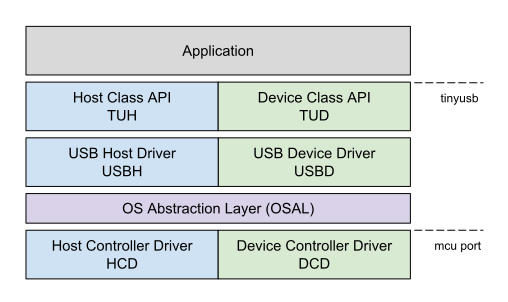
.
├── docs            # Documentation
├── examples        # Sample with Makefile and Segger Embedded build support
├── hw
│   ├── bsp         # Supported boards source files
│   └── mcu         # Low level mcu core & peripheral drivers
├── lib             # Sources from 3rd party such as freeRTOS, fatfs ...
├── src             # All sources files for TinyUSB stack itself.
├── test            # Unit tests for the stack
└── tools           # Files used internally
The stack supports the following MCUs
Here is the list of supported Boards that can be used with provided examples.
Support multiple device configurations by dynamically changing usb descriptors. Low power functions such as suspend, resume and remote wakeup. Following device classes are supported:
Most active development is on the Device stack. The Host stack is under rework and largely untested.
TinyUSB is completely thread-safe by pushing all ISR events into a central queue, then process it later in the non-ISR context task function. It also uses semphore/mutex to access shared resource such as CDC FIFO. Therefore the stack needs to use some of OS's basic APIs. Following OSes are already supported out of the box.
The stack is developed with GCC compiler, and should be compilable with others. Folder examples provide Makefile and Segger Embedded Studio build support. Here is instruction to build example.
Here is the details for getting started with the stack.
Want to help add TinyUSB support for a new MCU? Read here for an explanation on the low-level API needed by TinyUSB.
MIT license for all TinyUSB sources src folder, Full license is here. However each file is individually licensed especially those in lib and hw/mcu folder. Please make sure you understand all the license term for files you use in your project.
TinyUSB is currently used by these other projects:
Let's me know if your project also uses TinyUSB and want to share.